
The postwar landscape saw Switzerland emerge as the preeminent watchmaking capital. Hitherto, countries like Britain, Japan, and the United States held thriving industries that were subsequently co-opted into the war effort. Citizen made a concerted effort to expand sales outside Japan, creating the Citizen Trading Company in 1949 to control the global distribution and marketing of Citizen watches. Even still, it would be another six years before global exports began to take off.
The 1950s were pivotal for Citizen’s innovation. They launched Japan’s first calendar watch in 1952, its first shock-resistant watch in 1956 (the Parashock — the name the company still uses for its anti-shock system), its first alarm wristwatch in 1958, and its first water-resistant watch in 1959 (Parawater). On a company level, they introduced their first automatic caliber in 1958. The Citizen Deluxe, powered by their first central second’s caliber that same year, went on to sell over 100 million units.
The following decade saw Citizen steam on, entering an import-export agreement with American watchmaker Bulova in 1960 (more on them later) and introducing their first officially certified chronometer in 1962. Europe was next, with an office established in West Germany and full-fledged European exports beginning in 1965.

The 1960s also saw the advent of the quartz wristwatch by Japanese watchmaker Seiko, the result of which has come to be known as the “Quartz Crisis.” While many brands fell victim to its wake, Citizen had already been experimenting with electronic and quartz technology. In 1970, the brand launched the first titanium-cased watch, the X-8. Fewer than 2,000 of these electronic-movement equipped timepieces were ever produced. They also introduced their first automatic chronograph caliber in 1972, best known in its iconic Bullhead configuration, and their first quartz wristwatch in 1973.
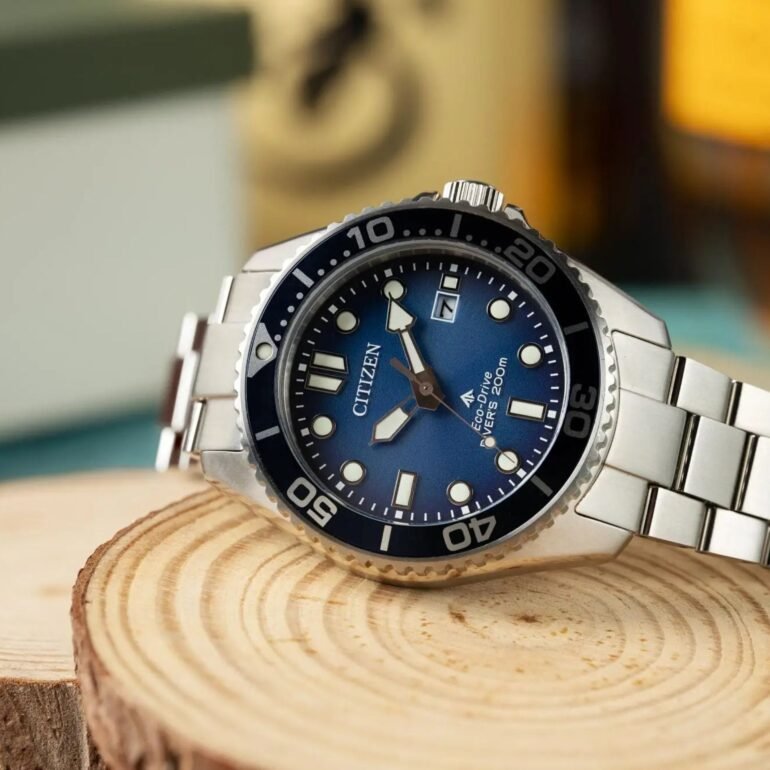
The 1980s saw Citizen head underwater. They had previously introduced their Challenge Diver in 1977, a watch perhaps best known for emerging from the depths, years later, encrusted in barnacles and still ticking. It was the dive watches of the 1980s, however, that would cement Citizen’s reputation as a titan of undersea timekeeping. The Professional Diver 1300m, released at the tail end of 1981, was not only the brand’s first titanium dive watch but also the most water-resistant watch in the world. Their true technical marvel came shortly after in 1985 — the Aqualand. In the world before the dive computer, monitoring bottom time and depth was crucial for following dive plans constructed using tables. The Aqualand combined a robust diver’s watch with a digital depth gauge, marking the pinnacle of the dive watch as a tool built for and used by divers. Citizen’s commitment to producing robust tool watches was codified into an ethos with the launch of the Promaster line in 1989. Producing watches designed to meet any conditions at Air, under the Sea, and on Land, today the Promaster series showcases Citizen’s continued dedication over the past 35 years to building the ultimate in tool watches.
Windup Watch Shop
2025-11-09 17:00:00