
:max_bytes(150000):strip_icc():format(jpeg)/Make-Dim-Sum-Frances-First-Michelin-Starred-Chinese-Restaurant-Shang-Palace-FT-DGTL1025-02-ca69de3841a9457197b6cd3639413ac5.jpg)
If you’re the kind of traveler who craves a hands-on experience — one you can literally taste — the Shangri-La Paris has just the dining adventure for you.
In the former home of Prince Roland Bonaparte, the five-star hotel overlooks the Eiffel Tower and River Seine in the 16th arrondissement. On top of providing its guests a glimpse into royal history and unparalleled city views, the Shangri-La Paris offers a top-notch food experience at Shang Palace, the only Michelin-starred Chinese restaurant in France.
Since its opening in 2011, Shang Palace has been serving guests of the Shangri-La Paris, and locals alike, with innovative and reimagined takes on traditional Chinese dishes with nods to French gastronomy. Executive Chef Tony Xu brings over 20 years of experience working in mainland China to the Parisian hotel, working alongside a team of culinary experts from Hong Kong who specialize in Chinese cuisine and together have perfected the art of dim sum.
The Art of Dim Sum experience invites guests into the kitchen at Shang Palace for a private, hands-on dim sum-making workshop led by the restaurant’s culinary team. For €550 (about $638) per person, the experience includes a guided tour of the kitchen, a cocktail at the hotel’s Bar Botaniste, along with a five-course dinner with a wine pairing.
During my stay at the Shangri-La Paris, I had the opportunity to partake in this experience. Upon arrival at Shang Palace, we were given aprons and escorted into the kitchen where chef Xu greeted us with an enthusiastic smile before setting us up with our own cutting boards, bamboo steamer baskets, and portioned-out ingredients. After learning about the technique and watching chef Xu’s demonstration, we started making the dough for the Red Dumplings by mixing beetroot juice with water, salt, potato starch, and flour.
We split up our dough into equal pieces and rolled it out to just the right level of thickness — which was much harder to do than chef Xu made it look — then we filled each dumpling with a mixture of ground chicken, mushrooms, soy sauce, sesame oil, herbs, and spices. My group struggled a bit when it came to folding the dumplings, with almost none of ours looking remotely similar to the example, but chef Tony was more than willing to provide guidance, crack a joke about our attempts, and issue hands-on corrections. After another round of dumpling making — this time with a shrimp and pork filling — our bamboo steamers were full of our creations — with minimal filling leakage!
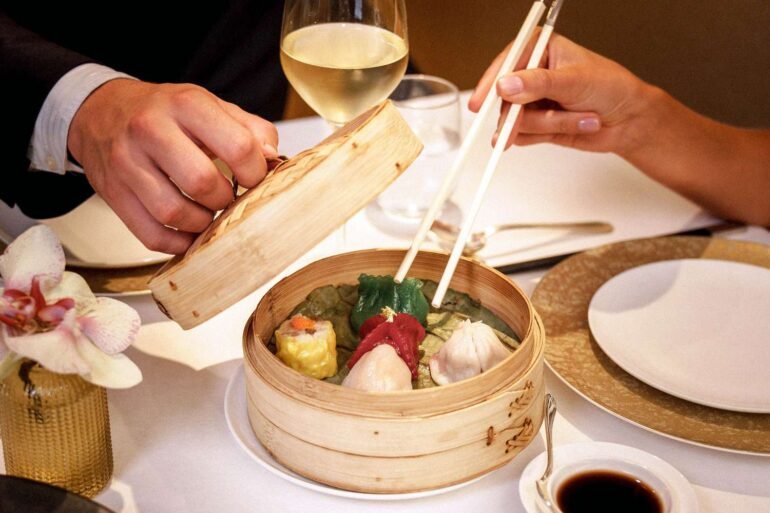
The workshop is followed by dinner in the main dining room. The menu is full of innovative and reimagined takes on traditional Chinese dishes, starting with an ice plant salad with sesame sauce followed by the dim sum we made, served to us in our individual bamboo steamer baskets. We enjoyed the fruits of our labor, and the dinner continued with sweet-and-sour foie gras, an unexpected and wonderful collaboration of Chinese and French gastronomy.
Then came a blue lobster Gong Bao with macadamia nuts that we tried not to fill up on before the main event: the roasted whole Peking duck, which was sliced tableside and served in two sequences: the first as sliced crispy duck skin with crêpes and the second as wok-fried minced duck breast served with lettuce wraps. The golden, glistening duck turned heads, and its rich, sweet, and savory flavors stole the show. Every bite of the perfectly roasted bird outdid the last.
Each course was impressive in its own right, and the dim sum was especially memorable — a dish I helped craft that found its way onto the table of a Michelin-starred restaurant. How many people can say that?
Alexa Rockwell
2025-10-26 13:28:00