
Let’s orient ourselves in the watch world five decades ago. The year is 1975, and we are in the height of the quartz crisis. Just six years prior in 1969, the watchmaking landscape forever changed with Seiko’s introduction of the first quartz timepiece, which called into question the future of mechanical timekeeping as we knew it. The era also marked the advent of the luxury sport watch, beginning with Gerald Genta’s Royal Oak for Audemars Piguet between 1970 and 1972. These two pivotal moments in horological history gave birth to an icon: the Girard-Perregaux Laureato.
The first Laureato entered Girard-Perregaux’s catalog in 1975. The model was modestly sized by today’s standards and was even rather mid-sized for the era with a case measuring just 36mm (by comparison, the first Royal Oak began to set the tone for more oversized watches clocking in at 39mm, but was considered notably large and given the nickname “Jumbo”). The 1975 Laureato featured a two-tone construction, highlighting its mix of curves and geometric shapes. The design echoed Genta’s but with softer edges and a slightly more elevated look thanks to the addition of yellow gold elements combined with stainless steel. In line with the times, the model housed a quartz caliber, but not just any quartz caliber – it was COSC-certified.

“The Laureato was more than just a new model for Girard-Perregaux’s catalog,” confirms Beatrice Morelli, Chief Customer Experience Officer. “It represented the brand’s resilience and relentless pursuit of innovation, even in the face of uncertainty in the industry.” Turns out, the birth of the Laureato was just a jumping off point. Over the next decade, Girard-Perregaux would double down on the advancement of its quartz calibers with the Laureato continuing to serve as the backdrop for these innovations. In 1984, the Maison introduced the Laureato “Equation” series, which featured more complex, chronometer-certified quartz movements. These models included the Equation Temps, Equation Soleil, and Equation Lune and expanded the functionality of the original 1975 Laureato by adding astronomical and calendar complications that made the movements significantly more intricate than the earlier, time-only quartz versions.
The 20th anniversary of the Laureato in 1995 marked a major milestone: the first mechanical version. This model was offered in two sizes (36mm and 38mm) and housed the brand’s in-house GP3300 automatic movement. Over the next ten years, Girard-Perregaux would shift its focus to evolving the mechanical possibilities of the Laureato with an important edition coming just three years later in 1998. Here, the Maison incorporated its signature “three bridges” concept into the collection with the Three-Bridges Laureato Tourbillon.
Into the new millennium, we have continued to see the Laureato evolve with Aston Martin editions that are skeletonized to ones with car paint on the dial, collaborations with industry pioneers like Bamford Watch Department, and even subsets of the collection like the Laureato Absolute – a sportier and more audacious and futuristic twist on the original. However, with each edition, certain elements have remained steadfast. “The Laureato’s design language has been remarkably consistent over the years,” affirms Morelli. “Its defining features are the octagonal bezel, integrated bracelet, and Clous de Paris dial,” she explains. “These elements are non-negotiable – they are the soul of the Laureato and what makes it instantly recognizable. Of course, the model has evolved but without losing its essence.”

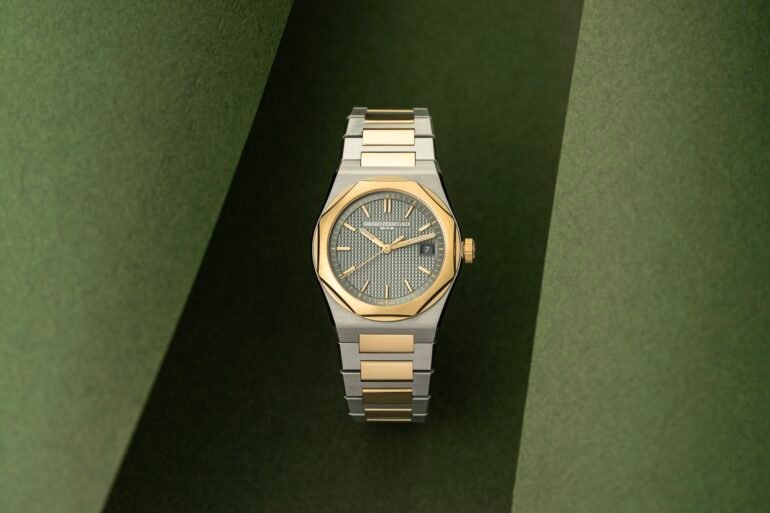
For the monumental 50th anniversary of the line, Girard-Perregaux has gone back to its roots with a classic homage piece heavily leaning on that core design language. This is most notably seen in the choice of material. “With this commemorative edition, we wanted to create a clear connection with the 1975 model, which was also made of yellow gold and steel,” describes Claude-Daniel Proellochs, Head of Product.

Here, the two-tone model takes on larger and more modern sizing than the original with a case measuring 39mm in diameter and 9.8mm thick. These proportions give the model a more contemporary oversized sport watch look and feel without being so bulky it loses its refinement. A reworking of the case architecture also enhances the sportiness with sharper angles and more pronounced bevels. Subtle modifications in the design extend to the integrated bracelet, which continues the two-tone aesthetic. In addition to the classic tapering with “H” links becoming progressively thinner toward the clasp, Girard-Perregaux has paid special attention to detail for comfort and fit thanks to shortening the links ever so slightly.

Despite the instantly recognizable design of the Laureato, the new anniversary edition is a mere vessel for the brand’s latest in-house caliber, which was just introduced last month. The Laureato Fifty marks the first model in Girard-Perregaux’s catalog to house the new GP4800 movement, visible through an exhibition caseback. The Maison is no stranger to developing its own calibers with a roster of more than 30 in-house movements to its name incorporating roughly 80 patents. However, developing a new caliber and a new design all for a milestone anniversary was no small feat – the pressure was on.
Cait Bazemore
2025-10-07 14:00:00